EzRadar is a phone app that lists the Wi-Fi and Bluetooth devices around you, tags their manufacturer prefixes, shows publicly reported camera locations on a map, and can display alerts from a separate Bluetooth radar detector you link — no fluff, just EZ.
On hold — not listed yet. A download is not offered here. Screenshots are SAMPLE renders, not photos of a phone and not anyone’s real location.
Legal use only. EzRadar is for lawful personal awareness. Do not use it to commit a crime, to evade law enforcement, or to intercept other people’s communications. Do not use it while driving; set it up or view it only when it is legal and safe. Recording laws vary, and you are responsible for following local law.
A dark radar and a list of the Wi-Fi and Bluetooth devices your phone can see. Scanning is passive: the app does not join networks or connect to devices, and sends no probes beyond the phone’s normal scan. Distance from the center is signal strength, not a measured range, and a dot’s angle is not a direction.
Manufacturer prefix tags
Tags manufacturer prefixes from the public IEEE registry — who was assigned that block of addresses — and flags a randomized MAC when the locally administered bit is set. A vendor match is not identification, and is not proof of law enforcement or surveillance.
Watch and Mute rules, optional alerts
Optional alerts when a device you watched appears. Optional Fleet and Priority vendor alerts are off by default, and Mute always wins. Follow devices, add local nicknames, and see signal-strength history. The details view shows why a device was flagged: registry owner, prefix length and confidence.
A map of reported places, not detections
Shows publicly reported camera locations, with the source, date and precision on each pin: official California speed-camera and red-light lists and Caltrans highway cameras, plus community-reported plate-reader locations nationwide. Pins are never matched to Wi-Fi or Bluetooth signals. The map is not complete or real-time.
Community-reported plate readers, offline
144,946 community-reported plate-reader locations in 50 states and DC, from OpenStreetMap (mostly mapped by DeFlock volunteers), as of 14 Nov 2026. Bundled, so the layer works offline. Not an official list and not every camera; pins may be missing, outdated or wrong. They are reported locations, not live detections.
Optional reported-camera alerts
An opt-in session plays a tone and shows a notification when your GPS position is near a reported camera pin. You start it; it never starts by itself, saves no route, and has a Stop button in its notification.
Optional official traffic
Official traffic reports from the agencies whose layers you turn on, such as California CHP and Caltrans, while that layer is on. Nearby Los Angeles-area scanner-feed links open in your browser or a scanner app; EzRadar does not play the audio itself.
Radar-band reference and detector link (beta)
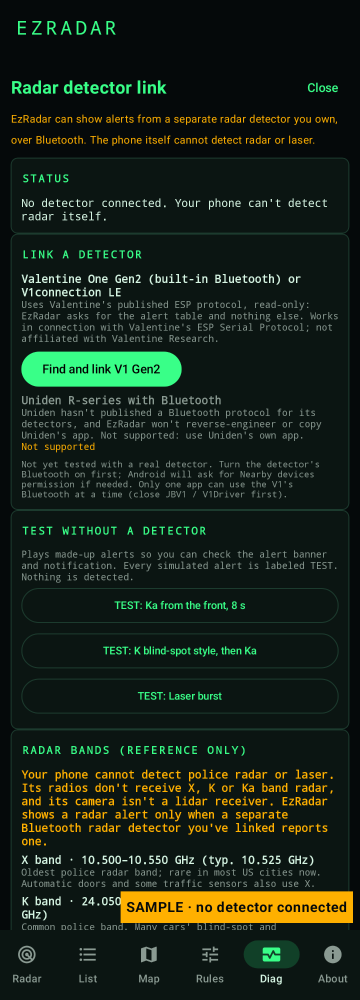
Your phone cannot detect radar or laser. EzRadar has a reference page for the common radar bands, and can show alerts from a Valentine One Gen2 (or a V1 with V1connection LE) you link over Bluetooth. Read-only, untested with a real V1, and not affiliated with Valentine Research. Uniden is not supported.
Recorder, app lock and Safe Mode
Optional user-started audio or rear-video recorder with a visible notification; it never starts by itself. An optional PIN app lock is an access barrier, not encryption. Safe Mode can hide addresses and network names in exports and the debrief.
Flipper Zero over USB (read-only)
Optional read-only USB link to a Flipper Zero: connection status and import of saved file metadata only. No transmit, replay or live radio through the Flipper.
What it does not do
It does not detect police, plate readers or cameras, and it does not identify people. A vendor prefix or a community-reported map pin is not detection of an agency, a camera or a product in the field. The app has no identity data.
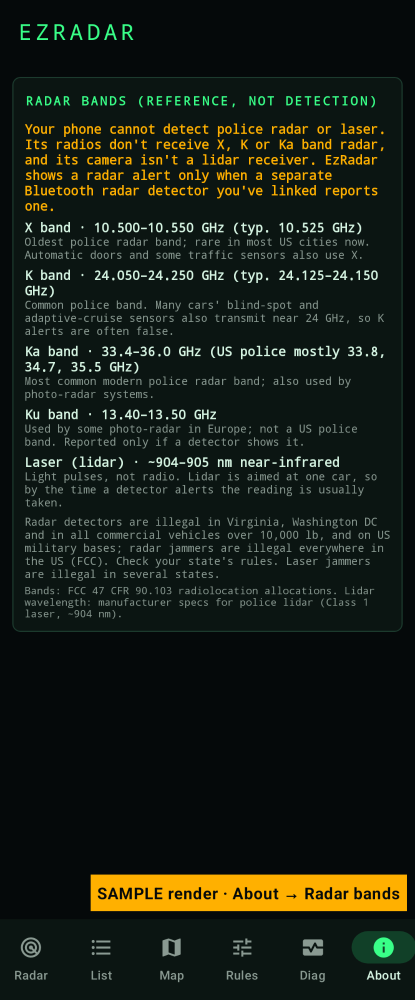
Your phone cannot detect radar or laser. Its radios do not receive those bands, and the camera is not a lidar receiver. Radar alerts come only from a linked Valentine One Gen2, and that link has not yet been tested with a real detector.
The map is not complete. Community-reported plate-reader pins are not every camera; a low count can just mean less mapping. Lists from other parties can be delayed, incomplete or outdated.
Signal strength is not distance, and the radar is not a direction finder. There is no guaranteed range. Many devices are silent or use random addresses, so one device can appear as several entries.
Android limits scanning. About four Wi-Fi scans per two minutes in the foreground and far fewer in the background. Some phones pause Bluetooth scans when the screen is off. Location services must be on for results on most Android versions.
It is not a police scanner. The phone cannot receive public-safety radio. Scanner features are links to third-party internet streams. A City of Los Angeles ordinance (LAMC 52.44) restricts listening to police radio in a vehicle without a permit; this is not legal advice.
Radar detectors are illegal in some places, including Virginia, Washington DC, commercial vehicles over 10,000 lb and US military bases. Jammers are illegal. EzRadar does not include a jammer.
Map Follow and Ahead are California-only in this build. Everything new in recent builds has not yet been tested on a phone.
Screenshots
These are sample interface renders from the app, not photographs from a phone. Some frames show sample data.
Sample render
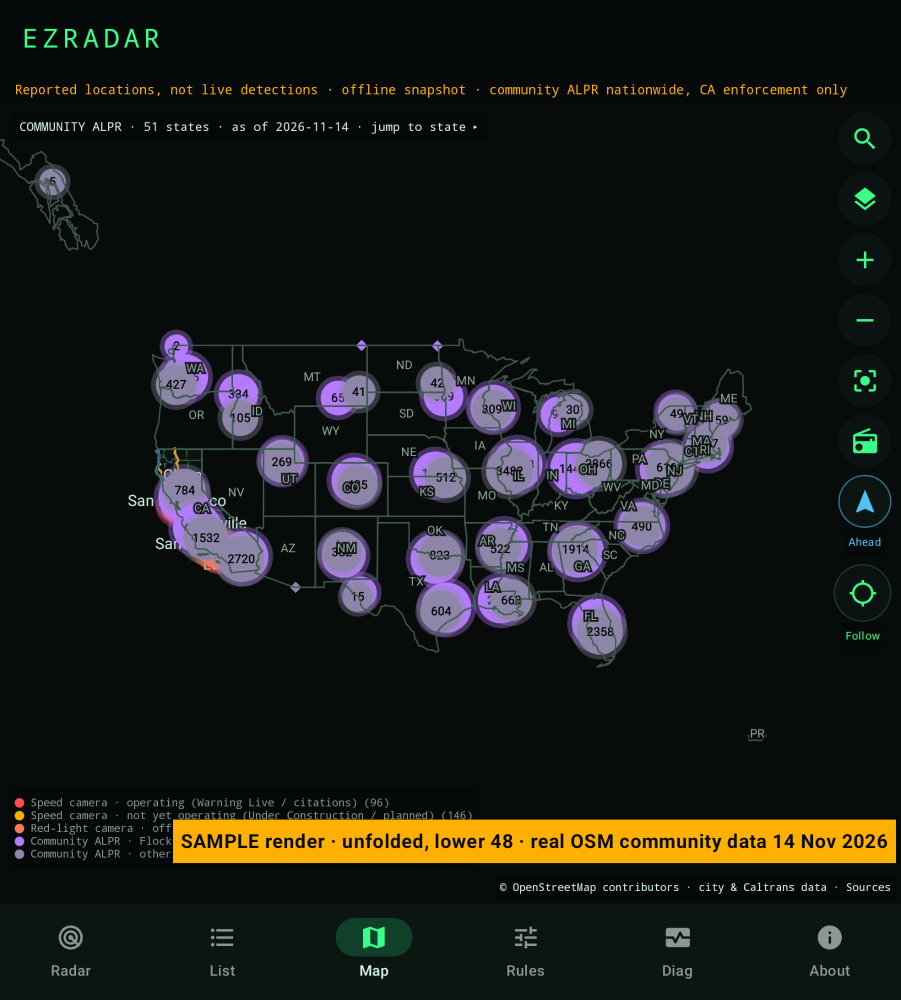
Community-reported plate-reader locations across the US, clustered on the map — an offline snapshot as of 14 Nov 2026, not live detections and not every camera. SAMPLE render.
Sample render
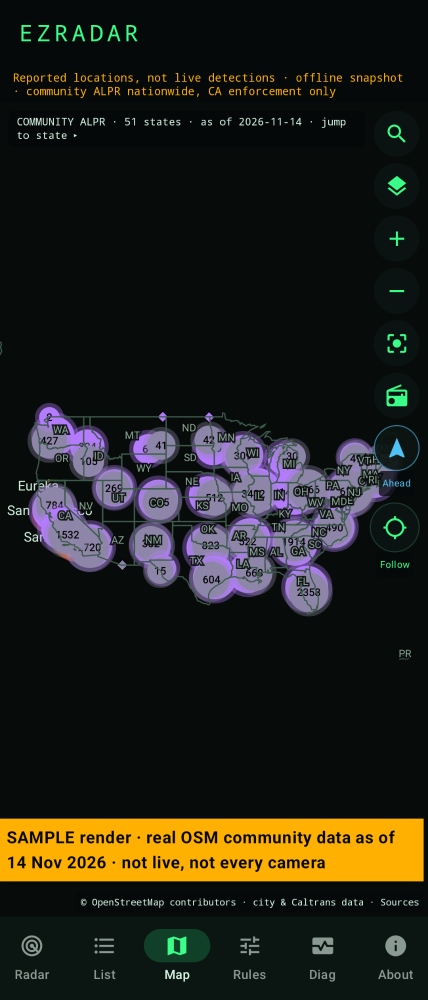
The same nationwide layer on a cover-sized phone screen, labeled as reported locations, not live detections. SAMPLE render.
Sample render
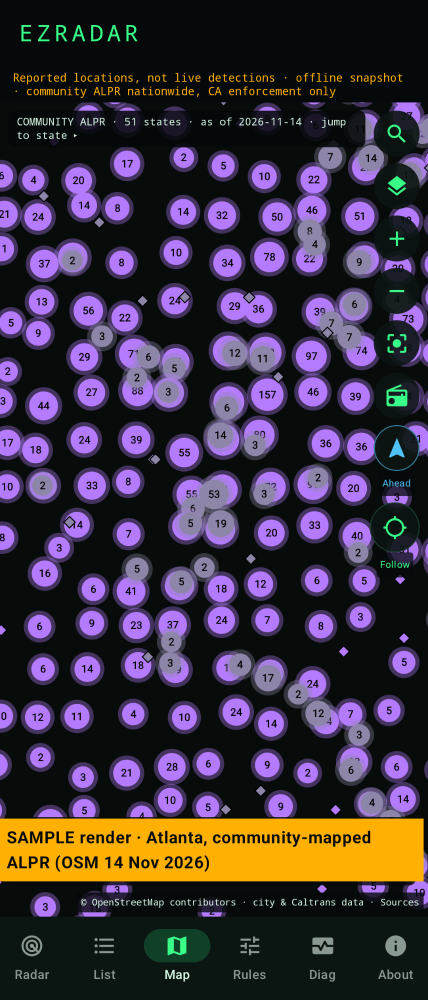
Zoomed in on community-mapped pins near one city; clusters split as you zoom in. OpenStreetMap data as of 14 Nov 2026 — no real user location. SAMPLE render.
Sample render
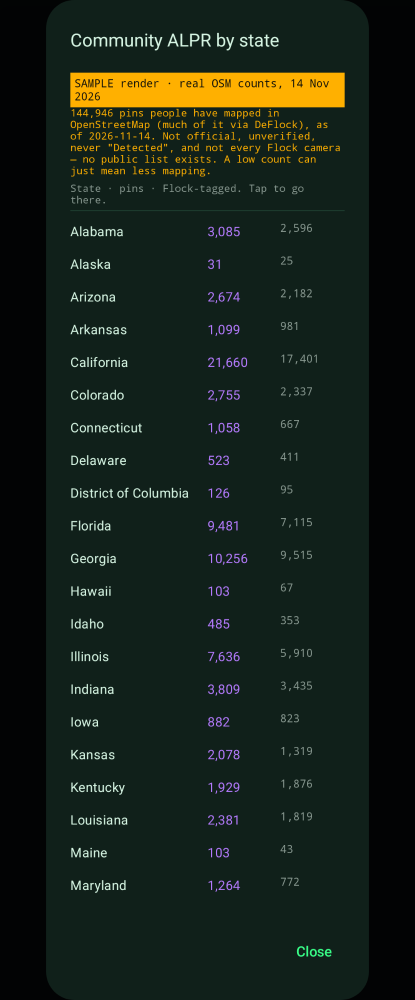
Per-state counts of pins people have mapped in OpenStreetMap (as of 14 Nov 2026) — not official, unverified, and not every camera. Tap a state to jump there. SAMPLE render.
Sample render
In-app reference for the X, K, Ka, Ku and lidar bands. Your phone cannot detect radar or laser. SAMPLE render.
Sample render
Optional Bluetooth link to a Valentine One Gen2 (beta, untested with a real V1). With nothing connected, the app says the phone can’t detect radar itself. SAMPLE render.
Sample render
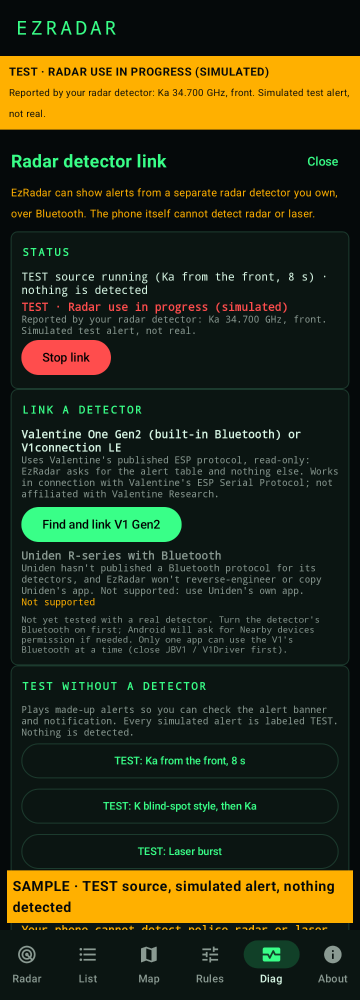
A built-in TEST alert previews the banner and notification without a detector — simulated, labeled TEST, nothing detected. The phone itself cannot detect radar. SAMPLE render.
Specs
Version
0.17.0 (build 23)
Platform
Android
Minimum Android
Android 8.0 (API 26); targets Android 15 (API 35)
Size
24.1 MB
Permissions
Wi-Fi state and location, because Android requires location for Wi-Fi and Bluetooth scan results (also used for optional map Follow and reported-camera alerts). Bluetooth scan and connect, for passive scanning and an optional detector link. Notifications and visible foreground services, each with Stop. Camera and microphone only for the recorder you start. Biometric, for the optional app lock. Internet only for optional Online features. No background-location permission.
Works offline
Yes. The scan, radar, list, manufacturer lookup, rules, exports, California camera lists and the community plate-reader layer are bundled and work with Online features off.
Data collected
None sent to TestaDura Labs. Scans, recordings, rules, signal history and your location stay on the phone unless you share an export. Optional Online features use HTTPS to official public traffic and camera hosts only; one switch turns all network use off. No ads or analytics. Android backup is turned off.
Last updated
15 Nov 2026
How to use it
Not available publicly. EzRadar is on hold. Install steps will be written when a download is offered.
Requirements
Android 8.0 (API 26) or newer; targets Android 15 (API 35). Location services must be on for Wi-Fi and Bluetooth results on most Android versions. A radar-detector link needs a Valentine One Gen2 or a V1 with V1connection LE. Not every feature has been tested on a phone yet.
Questions
Does it detect police, plate readers or cameras?
No. The map shows publicly reported camera locations — official lists and community reports, with the source on each pin. They are reported locations, not live detections, and the map is not complete or real-time.
Can my phone detect radar?
No. Your phone cannot detect radar or laser. EzRadar can only show alerts from a separate Valentine One Gen2 you link over Bluetooth. That link is beta and has not yet been tested with a real detector.
Is the plate-reader layer every camera?
No. It is 144,946 community-reported locations from OpenStreetMap, mostly mapped by DeFlock volunteers, as of 14 Nov 2026. No public install list exists, so pins may be missing, outdated or wrong.
Does it identify people or who owns a device?
No. It has no identity data. A manufacturer match only says who was assigned a block of addresses; the same hardware is sold to businesses, fleets and consumers.
Does it work offline?
Yes. Scanning, the radar and list, manufacturer lookup and the bundled map layers work with Online features off. Live traffic and camera stills need a connection and are optional.
Do my scans, recordings or location leave the phone?
Not on their own. They stay on the phone unless you share an export. Safe Mode can hide addresses and network names in those exports. There are no ads or analytics.
Download
Coming soon. A public download is not offered yet.